5 - Two Gaps and a Roofline: Driving an MX Dialect to Execution
The bar the generic postponed
Post 3 ended owing an answer. The scale operand's indexing map, (d0, d2 floordiv 32), cleared linalg.generic's verifier, which asks only whether the operands' maps taken together recover the iteration space. The structured vectorizer asks a stricter question of every map on its own, and the same floordiv fails it. Choosing a generic did not clear that bar. It postponed it, and this is where it comes due.
That is the first of two gaps between a lowering that verifies and code that runs. The second stops the pipeline before it reaches LLVM IR. Neither says what is wrong. The number at the end rises for two reasons, and only one of them is a win.
Everything below is written against llvm-project at revision 6f92180 (2026-05-19), the commit this dialect builds on. Where upstream has since changed something this post relies on, the change is noted at that point.
The schedule that tiles is short. It is Transform-dialect IR, data rather than compiled code, loaded into the pipeline and interpreted:
module attributes {transform.with_named_sequence} {
  transform.named_sequence @__transform_main(%root: !transform.any_op {transform.readonly}) {
    %matmul = transform.structured.match ops{["linalg.generic"]} in %root
      : (!transform.any_op) -> !transform.any_op
    %tiled, %loop_n, %loop_k =
      transform.structured.tile_using_for %matmul tile_sizes [0, 32, 32]
        : (!transform.any_op) -> (!transform.any_op, !transform.any_op, !transform.any_op)
    transform.yield
  }
}
The tile sizes are [0, 32, 32] over the iteration space (m, n, k). M is not tiled: it is already 32, and tiling it would produce a single-trip loop. N and K are tiled by 32, and the size on K is the one that matters. A K tile equal to the block size keeps each tile inside one MX block, so the block index is fixed for the whole tile.
The schedule is loaded by mlir-opt rather than mx-opt. Both are pass drivers, but mx-opt is this project's own, and it registers only the dialects the project needs, which does not include the Transform dialect or its Linalg extension. No mx ops survive --mx-to-linalg, so the second tool sees only upstream dialects.
$ mx-opt lower-matmul.mlir --mx-to-linalg \
    | mlir-opt --transform-preload-library='transform-library-paths=schedule.mlir' \
               --transform-interpreter
That produces the loop nest (payload elided; tiling leaves it unchanged):
#map = affine_map<(d0) -> (d0 floordiv 32)>
#map1 = affine_map<(d0, d1, d2) -> (d0, d2)>
#map2 = affine_map<(d0, d1, d2) -> (d0, d2 floordiv 32)>
#map3 = affine_map<(d0, d1, d2) -> (d2, d1)>
#map4 = affine_map<(d0, d1, d2) -> (d0, d1)>
...
      %1 = scf.for %arg6 = %c0_0 to %c64_1 step %c32_2 iter_args(%arg7 = %arg5) -> (tensor<32x64xf32>) {
        %2 = affine.apply #map(%arg6)
        %extracted_slice = tensor.extract_slice %arg0[0, %arg6] [32, 32] [1, 1] : tensor<32x64xf8E4M3FN> to tensor<32x32xf8E4M3FN>
        %extracted_slice_3 = tensor.extract_slice %arg1[0, %2] [32, 1] [1, 1] : tensor<32x2xf8E8M0FNU> to tensor<32x1xf8E8M0FNU>
        ...
        %3 = linalg.generic {indexing_maps = [#map1, #map2, #map3, #map4], iterator_types = ["parallel", "parallel", "reduction"]} ins(%extracted_slice, %extracted_slice_3, %extracted_slice_4 : tensor<32x32xf8E4M3FN>, tensor<32x1xf8E8M0FNU>, tensor<32x32xf32>) outs(%extracted_slice_5 : tensor<32x32xf32>) {
Two lines in that nest are why the K tile is the block size:
%2 = affine.apply #map(%arg6)
%extracted_slice_3 = tensor.extract_slice %arg1[0, %2] [32, 1] [1, 1] : tensor<32x2xf8E8M0FNU> to tensor<32x1xf8E8M0FNU>
#map is (d0) -> (d0 floordiv 32), so %2 is the block index, computed once per tile from %arg6, the loop counter of the enclosing scf.for, and hoisted above the generic. %extracted_slice_3 uses it to take a [32, 1] window of the scale, one block-column, and hands the generic a tensor<32x1xf8E8M0FNU>. Inside the tile the reduction runs over 32 contraction positions that all belong to one block, so the scale each row needs is a single value, constant for the entire reduction.
This is the point at which the tiled form should vectorize. Adding transform.structured.vectorize %tiled to the schedule, so that vectorization runs on the handle tiling returned rather than on a fresh match, gives:
<stdin>:7:10: error: Attempted to vectorize, but failed
The message names no cause, and its location is misleading: it points at line 7 of the input, the untiled generic, because the tiled op inherits the location of the op it was built from. Re-running with --debug-only=linalg-vectorization says what happened:
[linalg-vectorization Vectorization.cpp:2537] Attempting to vectorize: %3 = linalg.generic
  {indexing_maps = [affine_map<(d0, d1, d2) -> (d0, d2)>,
                    affine_map<(d0, d1, d2) -> (d0, d2 floordiv 32)>, ...]}
  ins(%extracted_slice, %extracted_slice_3, %extracted_slice_4
      : tensor<32x32xf8E4M3FN>, tensor<32x1xf8E8M0FNU>, tensor<32x32xf32>)
[linalg-vectorization Vectorization.cpp:2268] precondition failed: not projected permutations
[linalg-vectorization Vectorization.cpp:2545] Vectorization pre-conditions failed
The operand types in that dump are 32x32 and 32x1, so the op under consideration is the tiled one, not the original. The gate is allIndexingsAreProjectedPermutation, called from vectorizeLinalgOpPrecondition before any vectorization work begins. It requires every indexing map on the op to be a projected permutation, which rules out arithmetic on an iteration dimension. Three of the four maps qualify. (d0, d2 floordiv 32) performs a division on d2, and one map is enough to reject the op.
Tiling changed the scale's behavior: the value is now fixed across the tile's reduction, and the block index has been lifted into an affine.apply above the loop body. It did not change a character of the map, which still reads d2 floordiv 32. The precondition inspects the map's expression, so it sees the division and stops. An affine map stores an expression, not the range its dimensions take, so nothing in it records that d2 now runs to 32 instead of 64.
Untiled, the same refusal is the right call. The scale changes partway through the reduction, lanes covering k = 31 and k = 32 need different values, and there is nothing to broadcast. Tiling is what makes the access uniform, and the map is the same either way.
The access is not unvectorizable. It is unvectorizable as written.
What the map would have to become
Written differently, the same access vectorizes. Take the tiled nest exactly as the schedule emitted it and change one line:
-#map2 = affine_map<(d0, d1, d2) -> (d0, d2 floordiv 32)>
+#map2 = affine_map<(d0, d1, d2) -> (d0, 0)>
The map's second result stops being a division on d2 and becomes a literal. Nothing else moves: the extract_slice still cuts a [32, 1] window, the scale operand is still tensor<32x1xf8E8M0FNU>, and the loops, the affine.apply and the payload are untouched.
Vectorizing the edited nest needs a schedule that only vectorizes, since the file already holds the tiled loops:
module attributes {transform.with_named_sequence} {
  transform.named_sequence @__transform_main(%root: !transform.any_op {transform.readonly}) {
    %g = transform.structured.match ops{["linalg.generic"]} in %root
      : (!transform.any_op) -> !transform.any_op
    transform.structured.vectorize %g : !transform.any_op
    transform.yield
  }
}
Run against the edited file, it succeeds, with the map aliases reassigned in the output (loops and constants elided):
#map = affine_map<(d0) -> (d0 floordiv 32)>
#map1 = affine_map<(d0, d1) -> (d0, 0, d1)>
#map2 = affine_map<(d0, d1) -> (d0, 0, 0)>
#map3 = affine_map<(d0, d1) -> (0, d1, d0)>
...
        %2 = affine.apply #map(%arg6)
        ...
        %4 = vector.transfer_read %extracted_slice[%c0_9, %c0_9], %3 {permutation_map = #map1} : tensor<32x32xf8E4M3FN>, vector<32x32x32xf8E4M3FN>
        %6 = vector.transfer_read %extracted_slice_3[%c0_9, %c0_9], %5 {permutation_map = #map2} : tensor<32x1xf8E8M0FNU>, vector<32x32x32xf8E8M0FNU>
        %8 = vector.transfer_read %extracted_slice_4[%c0_9, %c0_9], %7 {permutation_map = #map3} : tensor<32x32xf32>, vector<32x32x32xf32>
        %10 = vector.transfer_read %extracted_slice_5[%c0_9, %c0_9], %9 : tensor<32x32xf32>, vector<32x32xf32>
        ...
        %15 = vector.multi_reduction <add>, %14, %10 [2] : vector<32x32x32xf32> to vector<32x32xf32>
The floordiv did not leave the program. #map on the affine.apply still computes the block index once per tile. What changed is that the scale operand's map no longer recomputes it on every iteration.
Each input is read into a vector<32x32x32> spanning the tile's (m, n, k) space, and each permutation_map says where that operand's own axes land among those three positions. A 0 marks a position the operand does not vary along, so one value is broadcast across the whole extent. The mantissa map (d0, 0, d1) puts rows at m and columns at k with a 0 at n. The B map (0, d1, d0) carries its 0 at m. The scale map (d0, 0, 0) is the only one with two zeros: it varies along m alone, so a single read per row serves every position in the tile. That is the access the block format was built for, now stated in the IR.
The last operation reads against that broadcast. vector.multi_reduction <add>, %14, %10 [2] collapses axis 2, the contraction axis, summing 32 products into each output element. Axis 2 is also the axis the scale's map broadcasts along, and the two are properties of different operands: the scale does not vary along it, the accumulator sums along it.
The literal is correct because tiling had already made the division redundant. tensor.extract_slice %arg1[0, %2] [32, 1] [1, 1] uses the block index in %2 to cut out one column. By the time the generic runs, one column is all it has, and inside the tile d2 ranges over 0 to 31, so d2 floordiv 32 returns 0 on every iteration. Writing 0 states what the expression evaluates to.
That the constant is admitted at all comes down to a parameter. allIndexingsAreProjectedPermutation calls isProjectedPermutation with allowZeroInResults set to true, while the method's own default in AffineMap.h is false. Constant-zero results are let through by an allowance the header marks for removal once they are supported more broadly. Arithmetic on a dimension is refused either way. Dropping the result entirely, for a map of (d0) over an operand with its unit axis removed, gives the same broadcast without relying on the allowance.
Untiled, either version would be a miscompile. The scale operand is the full 32x2, k sweeps 0 to 63 in one loop, and the two halves of that sweep need different columns; a map that always reads the first block would use its factor for all 64 positions. The rewrite is valid only where tiling has already confined k to one block, which is why it has to be recognized rather than simply applied.
The range the verifier already knows
The one-line edit was made by hand. Checking whether anything upstream makes it starts from the tiled nest as the schedule emitted it, with d2 floordiv 32 still in the scale map. Every pass registered in mlir-opt at this revision was tried on that nest, one at a time. Of those that accept it, none rewrites the scale map. The two transform ops that expose the same folding patterns leave it unchanged. No test under mlir/test/Dialect/Linalg starts from a linalg map containing a floordiv.
The candidate that should have caught it is unit-dim folding. The 1 in tensor<32x1xf8E8M0FNU> is why the column index can only ever be 0, and --linalg-fold-unit-extent-dims exists to remove size-1 axes from linalg ops. It is not inert on this operand: it rank-reduces the scale slice to tensor<32> and then expands it straight back to tensor<32x1>, because a map needs one result per axis and the generic's scale map still has two. What it never edits is the map.
The reason is how it decides an axis can go. Its isUnitDim check clears a size-1 axis for removal only when the index into it is the constant 0: either written as 0, or reducing to 0 after the loops being dropped, those with a single iteration, are replaced by zero. Every loop in the tile runs 32 times, so no loop is dropped and nothing is substituted; the test comes down to whether the index is written as 0. d2 floordiv 32 is not, and the check has no way to see a zero that holds only because d2 stops at 31. Hand the same pass the edited map, with its literal 0, and it removes the axis and rewrites the map to (d0) over tensor<32xf8E8M0FNU>.
The fact the edit relies on is already in the op, and the verifier computes it. The map says which column to read for a given d2, not how far d2 goes; the operands do. The mantissa slice is 32 columns wide and read at column d2, so d2 stops at 31. The verifier behind IndexingMapOpInterface inverts the indexing maps taken together to recover how many times each loop runs, the same whole-system inversion that let the floordiv through in Post 3. It then evaluates every map result at the first and last iteration and checks it against the operand's size. For d2 floordiv 32 both ends come out 0, and a division that never decreases as d2 grows cannot be anything else in between. Change the divisor to 16, so the last iteration asks for a second column, and the op no longer verifies:
probe-oob.mlir:21:14: error: 'linalg.generic' op inferred input/output operand #1 has shape's dimension #1 to be greater than or equal to 2, but found 1
The verifier works out that the index is always 0 and uses it to accept the op. None of the passes tried uses it to simplify the map.
What is missing is a rewrite that asks the verifier's question and keeps the answer. It would evaluate each map result that is not a bare dimension at the first and last iteration of the loops the operand shapes imply, and replace the result with that constant wherever both ends agree and the expression moves in one direction as its dimensions grow. On the untiled op the ends are 0 and 1, so it leaves the map alone, which is the recognition the edit required. The rewrite is not specific to block scales: any map result pinned to a constant by the loop it sits in qualifies. Building it belongs to a later version of this dialect.
What v1 ships is the tiled form. The next question is whether any of it runs.
Where the f8 conversion stops
Measuring anything means running it, and running it means getting the module down to LLVM IR. Two things stood between the bufferized dialect and a running binary: one pass ordering that is not arbitrary, and one conversion that had no implementation.
The ordering first. Most of the chain is mechanical, but two steps have to go in a fixed relative order, and the reason is the block scale:
  ...
  --convert-linalg-to-loops
  --lower-affine
  ...
In the bufferized linalg.generic, the expression d2 floordiv 32 sits inside the indexing map. A map is an attribute on the op, a piece of compile-time data describing how operands are read, and nothing in the module computes it. The generic has no explicit loops and no explicit index arithmetic; the indices are implied by the maps. --convert-linalg-to-loops changes that. Expanding the generic into scf.for means every index now has to be computed by some operation, and the expression appears as an affine.apply, an op that evaluates an affine map on index values and yields an index. The bufferized module contains no affine.apply; after the loop conversion there is one.
--lower-affine is the pass that turns affine.apply into ordinary arithmetic, so it can only run once one exists. Placed earlier it would walk a module where the block index is still a subexpression inside an attribute, find nothing to lower, and report success. The failure would surface much later, as an unlowered affine op arriving at a stage that cannot handle it. The constraint looks like pass-ordering trivia and comes directly from a decision made several stages earlier: put the block index in an affine map, and the pass that lowers affine ops has to wait until something materializes it.
With that settled the chain runs to completion. What comes out is LLVM dialect except for one operation.
A small probe isolates it. probe-f8-extf.mlir holds two functions, each taking an eight-bit float as an argument (which avoids compile-time folding), each widening it to f32:
func.func @extf_e4m3(%x: f8E4M3FN) -> f32 {
  %0 = arith.extf %x : f8E4M3FN to f32
  return %0 : f32
}
func.func @extf_e8m0(%y: f8E8M0FNU) -> f32 {
  %0 = arith.extf %y : f8E8M0FNU to f32
  return %0 : f32
}
The obvious thing to reach for does not exist here:
$ mx-opt probe-f8-extf.mlir --arith-expand="include-f8e4m3fn=true"
error: <Pass-Options-Parser>: no such option include-f8e4m3fn
Its counterpart for the scale type does:
$ mx-opt probe-f8-extf.mlir \
    --arith-expand="include-f8e8m0=true" \
    --convert-arith-to-llvm --convert-func-to-llvm --reconcile-unrealized-casts
llvm.func @extf_e4m3(%arg0: i8) -> f32 {
  %0 = builtin.unrealized_conversion_cast %arg0 : i8 to f8E4M3FN
  %1 = arith.extf %0 : f8E4M3FN to f32
  llvm.return %1 : f32
}
llvm.func @extf_e8m0(%arg0: i8) -> f32 {
  %0 = llvm.mlir.constant(23 : i32) : i32
  %1 = llvm.zext %arg0 : i8 to i32
  %2 = llvm.shl %1, %0 : i32
  ...
  %7 = llvm.bitcast %6 : i32 to f32
  llvm.return %7 : f32
}
The scale conversion is gone, rewritten as integer work on the byte. The mantissa conversion is still there, spelled exactly as it was written, inside a function that is otherwise LLVM dialect. Above it sits a cast turning the incoming i8 back into f8E4M3FN, left behind because the operation it feeds never converted.
Both signatures became i8, so both types were handled. Only one of the two operations was. With no eight-bit float arithmetic on the CPU path to lower to, the conversion has to be emulated with integer operations, and some pass has to supply that emulation. --arith-expand supplies it for f8E8M0FNU and, on this build, for nothing else.
Handing the result to mlir-translate ends the attempt:
error: Dialect `arith' not found for custom op 'arith.extf'
The translator does not register arith, so a module still carrying an arith operation cannot be parsed at all. No LLVM IR comes out, and the backend never sees the conversion. What the backend would have done with it is a question this attempt never reaches.
Upstream has since closed the gap. Commit c3c6e286e7eb9, landed 1 September 2026, adds the missing expansion for f8E4M3FN in both directions and exposes it as include-f8e4m3fn. That is a little over three months after the build this post is pinned to.
So the two gaps are not the same kind of thing. The vectorizer refused: a check was in place, doing what it was written to do, and getting past it needs a rewrite that none of the passes tried performs. It is still open. This one was not a refusal. No check stood in the way; the implementation was absent, and it has since landed.
That does not restore the measurement. An emulated conversion is a sequence of integer operations standing in for hardware that is not present, and timing it measures the stand-in. What the format actually changes is how many bytes move, and that can be counted without running anything.
What the intensity number is made of
The roofline for this workload is computed from the bufferized memref types: shape times element width, each buffer counted once.
Three numbers describe a workload on a machine. Operational intensity, written I, is how many floating-point operations the workload performs per byte it moves, and it belongs to the workload. Bandwidth, BW, is how fast the machine moves bytes, and peak rate, P_peak, is how fast it does arithmetic; both belong to the machine. Attainable performance is whichever ceiling binds first:
$$P = \min(P_{\text{peak}}, \text{BW} \times I)$$
The two ceilings meet at an intensity called the ridge, P_peak / BW, a fixed property of the hardware. Quantization does not move the ridge. It changes I, sliding the workload along a roof that stays put. The machine here is a base M4, whose 120 GB/s of LPDDR5X bandwidth Apple publishes; its peak arithmetic rate is not published, and the figure used here, 560 GFLOP/s, is reverse-engineered from core count, FMA units, lane width and clock. The plot draws the ridge as a band, 30% either side, for that reason.
For M=32, N=64, K=64 with a block size of 32, against an all-f32 baseline:
| bytes | FLOPs | I | |
|---|---|---|---|
| f32 | 32,768 | 262,144 | 8.00 |
| mx | 26,688 | 393,216 | 14.73 |
Intensity rises by 1.84×, and that is the least useful number here, because it is a product of two effects that mean opposite things:
$$1.84 = 1.23 \times 1.50$$
The 1.23× is the byte ratio and it is the data-movement result. The 1.50× is FLOP inflation: the mx payload performs three floating-point operations per point where the baseline performs two, the extra one being the multiply that reconstructs A from its mantissa and scale. Intensity is FLOPs over bytes, so moving fewer bytes raises it and doing more arithmetic raises it too. Only the first is a win.
The 1.23× byte ratio itself needs unpacking, because larger and more flattering numbers are available. Narrowing the mantissa from f32 to f8E4M3FN is exactly 4× on those bytes, 8,192 down to 2,048. Add the block scale back and A as a whole goes from 8,192 to 2,112, or 3.88×. But B and the accumulator are still f32 in v1:
f32   AAAAAAAABBBBBBBBBBBBBBBBCCCCCCCC  32,768 bytes
mx    AABBBBBBBBBBBBBBBBCCCCCCCC        26,688 bytes

A = A operand (mantissa + scale)   B = B operand   C = accumulator
1 character = 1 KiB, widths rounded
A shrinks to a quarter of its width while the 24,576 bytes of B and the accumulator do not move at all. A 3.88× reduction on one operand is a 1.23× reduction on the working set. The 4× is a true statement about a format; the 1.23× is a true statement about this workload.
Both intensities sit in the wrong region to show what quantization is for. With this machine's bandwidth and peak the ridge falls near 4.7 FLOPs per byte, and 8.00 and 14.73 both sit above the band around it, so both are compute-bound. The movement is inside the compute-bound region, not a crossing out of the memory-bound one. That is not because the problem is small. It follows from the reuse in a matmul: each element of A feeds N products and each element of B feeds M, so the f32 baseline alone performs 262,144 operations over 32,768 bytes and sits above the ridge before anything is quantized.
The regime where the memory result would appear is decode. In language-model inference, prefill processes the whole prompt at once and decode generates one token at a time, which means the activation matrix has a single row: M = 1. The baseline FLOP count is 2·M·N·K and scales with M, so it collapses. The B operand is K×N and has to be read in full regardless of how many rows it multiplies. Little arithmetic over the same weight bytes puts intensity far below the ridge, and the workload becomes memory-bound.
That regime also shows what v1 does not buy. At M=1 the A operand is one row of 64 values, 256 bytes against B's 16,384, so quantizing it moves the total from 16,896 bytes to 16,706. Intensity still rises 1.52×, and 1.01 × 1.50 is where it comes from. Almost the entire apparent gain is the dequantization multiply, and the memory win is a rounding error.
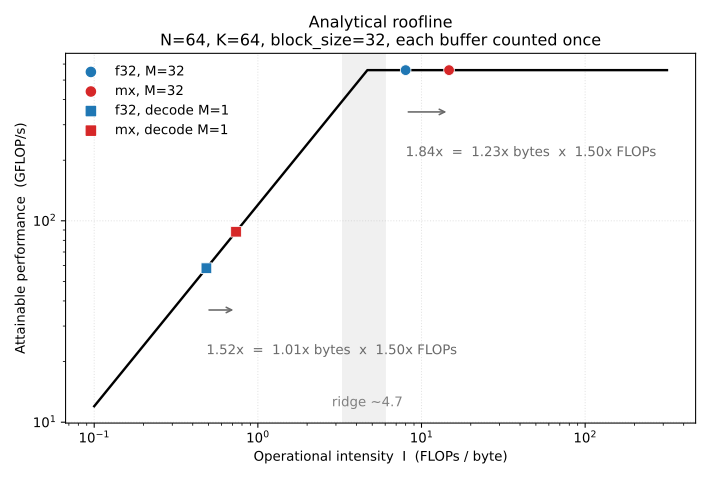
Both shapes move rightward, which is what an optimization is supposed to look like, and at neither shape is the movement mostly a memory result. The plot cannot separate the byte saving from the added arithmetic, which is why each arrow is labelled with its decomposition rather than the shift alone.
Reading the same model as a duration
The roofline's axes are intensity and rate. Neither is time, and time is what quantization is supposed to improve.
The same two ceilings give it:
$$T = \max\left(\frac{\text{Bytes}}{\text{BW}},\ \frac{\text{FLOPs}}{P_{\text{peak}}}\right)$$
Moving the data and doing the arithmetic happen at once, so whichever takes longer sets the duration. That is the attainable-rate formula seen from the other side, since dividing the work by the lower of two rates gives the longer of two times. Both inputs are ceilings, so the durations that come out are floors: the best case, not a prediction.
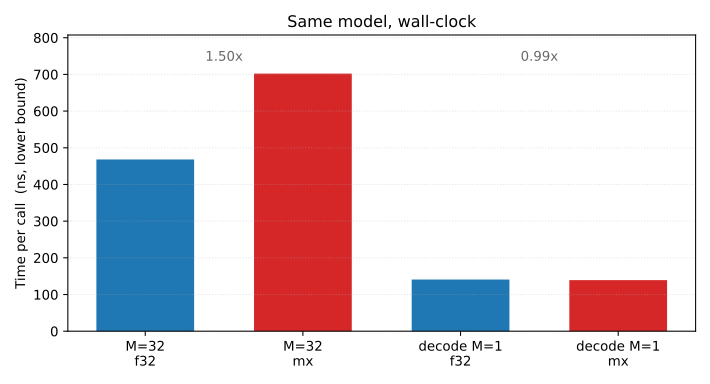
At M=32 the arithmetic ceiling binds, so the mx path performs 1.5× the operations at the same peak rate and takes 1.5× as long. Both points sat on the roofline's ceiling at the same height, and the one further right is the slower one.
At M=1 the bandwidth ceiling binds, and 16,706 bytes against 16,896 is a 1% difference, so the two durations are level at about 140 ns. The roofline nevertheless puts the mx point at 88 GFLOP/s against the baseline's 58. GFLOP/s counts operations per second, and the mx path performs 1.5× the operations in the same time, so the rate rises. The operations it added are dequantization: work that unpacks the format rather than producing any part of the answer. The axis cannot tell a multiply that computes the result from one that undoes the compression, and it credits both.
The ratios are worth more than the absolute nanoseconds. Real code reaches some fraction of each ceiling, so every absolute duration here is too short by some factor. A ratio of two durations is the more portable number: if both precisions reach a similar fraction of peak, dividing both durations by that fraction leaves the 1.5× at M=32 unchanged. That is an assumption rather than a guarantee: the mx path loads one-byte values, widens them with an emulated conversion, and carries an extra multiply. If it reaches a lower fraction of peak than the baseline, the real gap is wider than the model's 1.5×, never narrower: the arithmetic ceiling binds at M=32, and more arithmetic against the same ceiling can only take longer.
That extra arithmetic is not inherent to the format. Post 3 lowers mx.block_matmul to a single fused linalg.generic, reconstructing each A value inside the loop nest rather than materializing a dequantized f32 tensor first. The reconstruction therefore sits inside the n loop and runs once per output column: M·N·K multiplies, 131,072 at this shape, where dequantizing A once would have cost M·K, or 2,048. Added to the baseline's 262,144 operations, that is the entire 1.50×. Fusion buys the f32 intermediate never being written, at the cost of arithmetic, which is the right trade when the problem is memory-bound and the wrong one when it is compute-bound.
So neither shape comes out faster. At M=32 the mx path takes 1.5× as long; at M=1 the two are level, within 1%. That is the state of A-only quantization with B and the accumulator still in f32: the extra multiply is paid on every point and the byte saving is too small to repay it.
The modelled durations inherit the uncertainty in the reverse-engineered peak rate. At M=32 both variants are bound by FLOPs / P_peak, so a different peak moves both bars and leaves the 1.5× between them intact. The intensity values do not depend on it at all, since FLOPs / Bytes comes from the shapes and element widths alone.
What the diagnosis bought
The dialect lowered, bufferized, and tiled without incident. Then the vectorizer refused the scale map, no pass would write the zero the verifier had already worked out, the f8 conversion had no implementation on the CPU path, and the intensity number at the end folded a saving and an overhead into one figure.
Both gaps were real on llvm-project at 6f92180. The f8 conversion has since been implemented upstream, so a build from today lowers what this one could not. The vectorization gap remains: closing it needs a rewrite that recognizes a map result fixed at a constant by the loop it sits in, and none of the passes tried performs one. isUnitDim, the check that comes closest, is unchanged at HEAD. Any block-scaled format whose scale map indexes blocks with a floordiv meets the same wall.
What v1 has is the lowering and the byte accounting. Four ops, a parameterized type, three canonicalizations, a conversion to linalg on tensors, a 1:N split that bufferizes copy-free, and a tiled schedule whose block-aligned K makes the broadcast form reachable. The byte model built on that works from types and shapes, so it can price a change the code does not implement, which is how a quantized B gets a number below without existing. The code, the tests, and the scripts behind every number in this post are in the mlir-mx repository.
What v1 does not have is a speedup. Quantizing A pays at neither shape, because at M=32 arithmetic binds and at M=1 A is a rounding error against B. Quantizing B is what moves the decode point. Under the same byte arithmetic, quantizing both operands at M=1 takes the working set from 16,896 bytes to 4,546 and the modelled time from 141 ns to 38 ns, still memory-bound, so the time ratio and the byte ratio are the same 3.7×. That is a projection from the type information rather than a result, and a second version would make it one: quantize B, build the missing rewrite, and measure on a target that converts f8 natively rather than emulating it.
The series worked down one pipeline, a stage per post. Post 1 put a block scale into a type. Post 2 found the power-of-two structure in the scale format and what it makes exact. Post 3 reduced block-scaled matmul to one floordiv in one affine map. Post 4 split one value into two buffers and accumulated in place. This post took all of it to the last stage, located the two points where upstream stops, one before vectorization and one before translation, and priced the result from the types the earlier posts built.